Bloom Sentry
Developers: Franz Benjamin Africano, Matt Terrence Rias, Mohammad Rafi Saiyari, Beau Lawyjet Sison
Completion Date: July, 2025
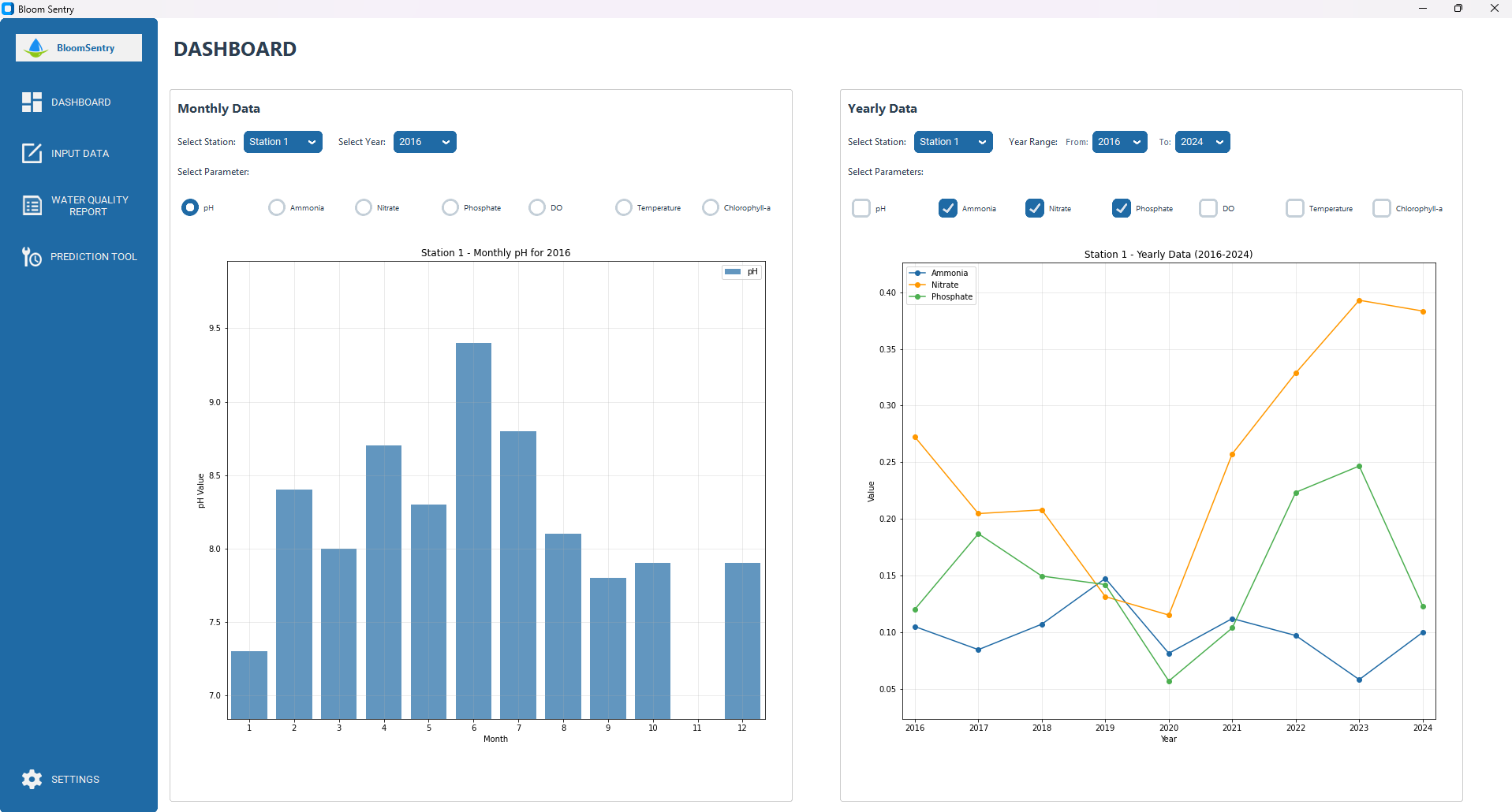
This undergraduate thesis project focuses on developing a predictive model for algal blooms in Laguna Lake, a critical environmental issue. The project utilizes the Gradient Boosting Regression (GBR) algorithm to forecast the levels of algal bloom-causing parameters, specifically chlorophyll-a and phytoplankton. By analyzing historical data on water quality, nutrients, and weather patterns provided by the Laguna Lake Development Authority (LLDA) and PAGASA, this research aims to create a tool that can provide early warnings, enabling proactive measures to mitigate the ecological and economic damage caused by harmful algal blooms (HABs).
Statement of the Problem
This study aimed to develop a predictive model to forecast algal bloom occurrences in Laguna Lake. It sought to answer the following questions:
- What are the significant parameters (e.g., pH, temperature, nitrate, phosphate) that correlate with algal blooms?
- How can a Gradient Boosting Regression (GBR) model be developed and trained to predict algal bloom indicators (chlorophyll-a and phytoplankton) using historical data?
- What is the performance level of the developed GBR model in terms of accuracy, precision, and error (MAE, MSE, R²)?
- How can the model be implemented into a functional tool to serve as an early warning system for stakeholders like the LLDA?
Scope and Limitations
This research is subject to the following scope and limitations:
- Data Dependency: The model's accuracy is entirely dependent on the quality, completeness, and timeframe of the historical data provided by the LLDA and PAGASA.
- Geographic Scope: The study focuses exclusively on Laguna Lake and its designated monitoring stations. The findings may not be generalizable to other bodies of water without retraining.
- Model Focus: The project implements Gradient Boosting Regression (GBR). While other machine learning models exist, the scope is limited to the implementation and evaluation of GBR.
- Output: The primary output is a predictive model. The development of a full-scale, real-time, user-facing application (like a web or mobile app) is considered a future enhancement, not part of the core thesis delivery.
Technologies & Methodology
The project followed a quantitative, correlational research design to determine the relationship between environmental variables and algal bloom indicators.
- Core Technologies:
- Language: Python
- Core Libraries: Pandas, NumPy, Scikit-learn
- ML Algorithm: Gradient Boosting Regression (GBR)
- Data Visualization: Matplotlib, Seaborn
- Analysis: Pearson's R correlation
- Methodology:
- Data Collection: Acquired historical water quality data (Phosphate, Nitrate, pH, Temperature, Chlorophyll-a, Phytoplankton) from LLDA and meteorological data (Rainfall, Wind Speed) from PAGASA.
- Data Preprocessing: Cleaned the dataset by handling missing values through interpolation. Merged and synchronized datasets from the two different sources.
- Feature Engineering & Selection: Applied Pearson's R correlation to identify and select the most significant environmental parameters that influence algal blooms.
- Model Training: Split the processed data into training (80%) and testing (20%) sets. Implemented and trained the Gradient Boosting Regression (GBR) model on the training data.
- Model Evaluation: Assessed the model's predictive performance on the unseen test data using standard regression metrics: Mean Absolute Error (MAE), Mean Squared Error (MSE), Root Mean Squared Error (RMSE), and R-squared (R²) to determine its accuracy and reliability.
Key Findings & Conclusion
The research successfully demonstrated that a Gradient Boosting Regression model can be effectively utilized to predict algal bloom indicators in Laguna Lake with a significant degree of accuracy. The model confirmed a strong, predictable relationship between key environmental factors and the proliferation of algae.
- The model achieved a high R-squared (R²) value, indicating that it could explain a large portion of the variance in the algal bloom data, proving its viability as a forecasting tool.
- Key parameters, particularly Phosphate, Nitrate, and Water Temperature, were statistically confirmed as the most significant predictors of algal bloom events in Laguna Lake.
- The project concludes that machine learning provides a powerful, data-driven, and cost-effective method for environmental monitoring. The developed model can serve as the core component of an early warning system, enabling the LLDA and other stakeholders to transition from reactive to proactive management of harmful algal blooms.